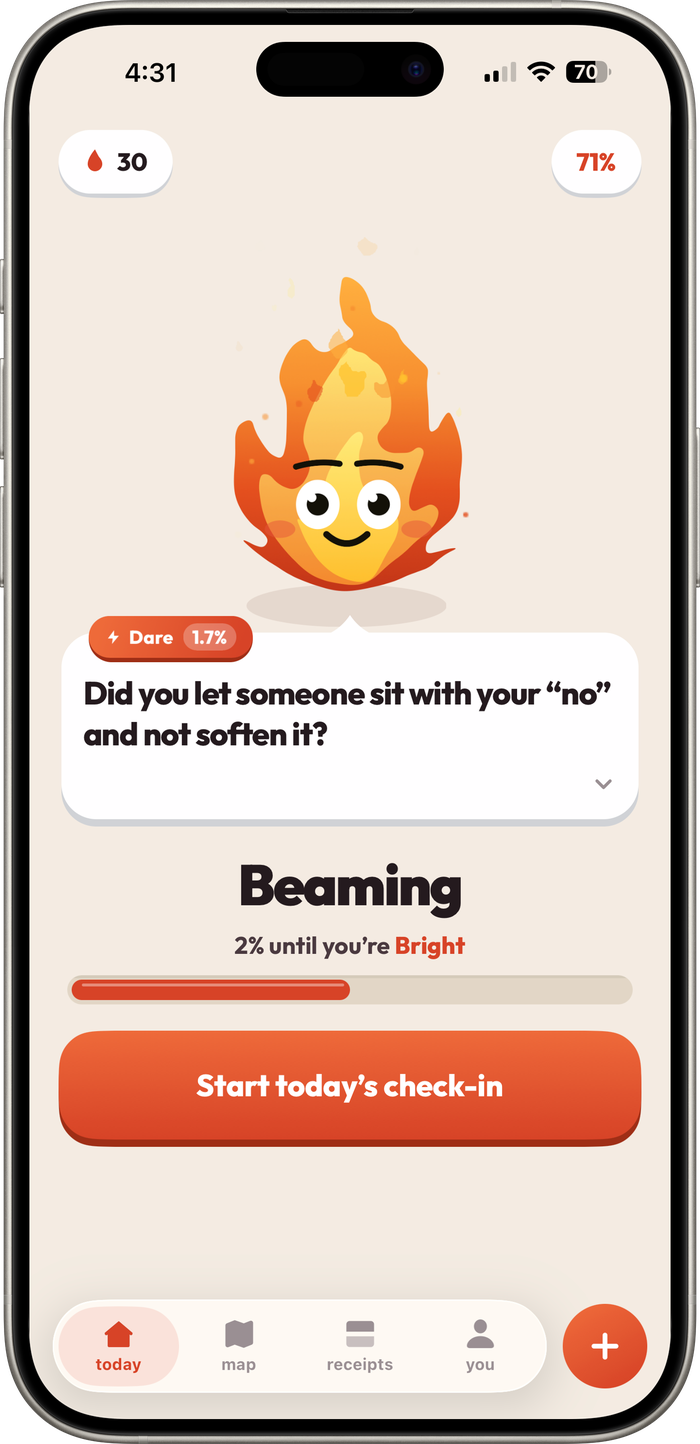
The glow up that starts on the inside. Get back the parts of you that you filed down to keep everyone else comfortable, one small dare at a time, with a number that goes up.



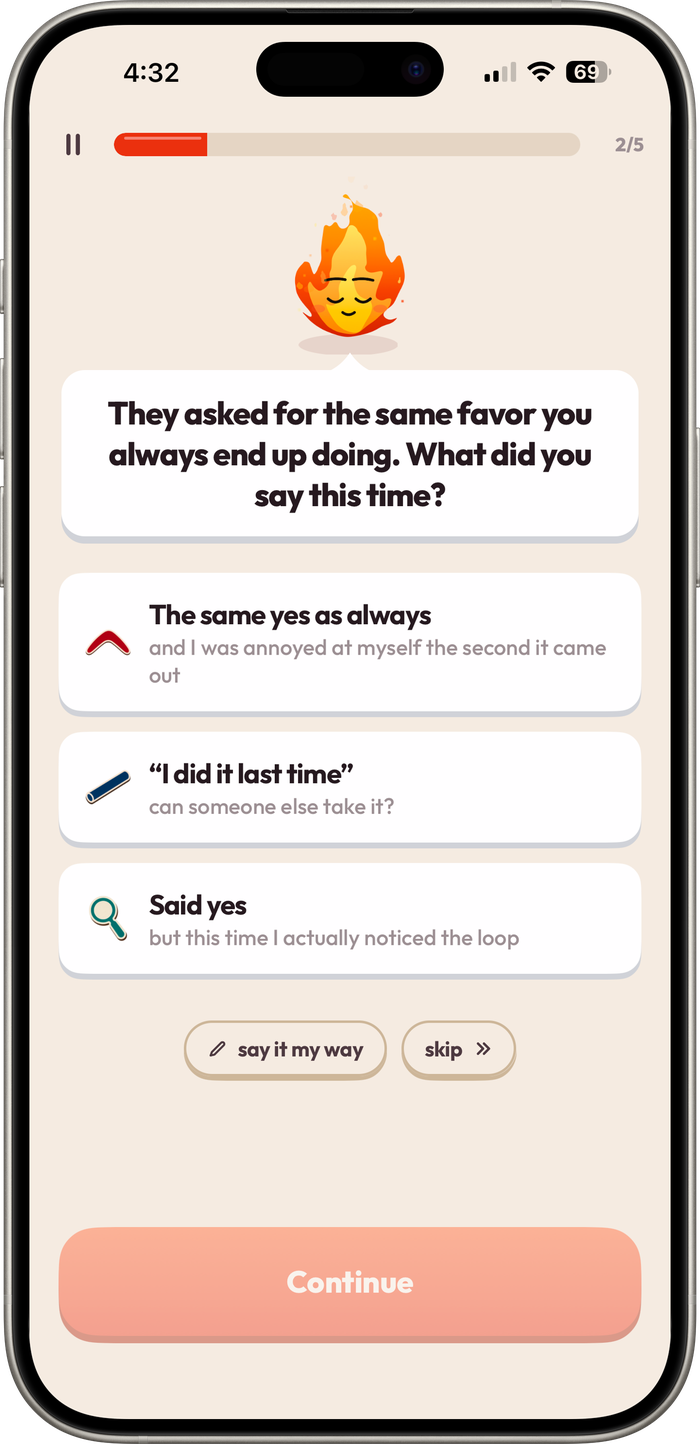
Thirty seconds, tapping. She names the pattern behind what happened, and every tap counts against it.
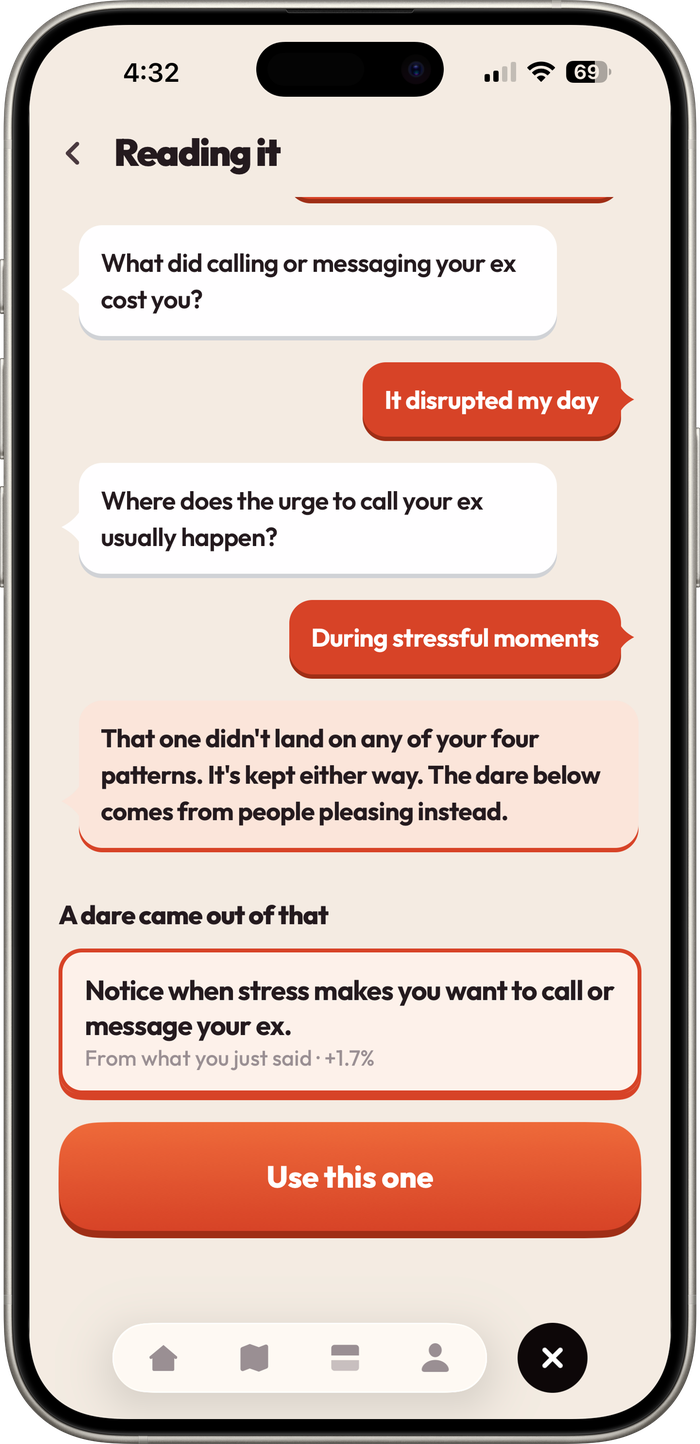
Written from your own answers and small enough to do this week. Do it and your number moves. Skip it and it waits.
Type what happened, however long. She asks one question at a time until it turns into what to do next time.
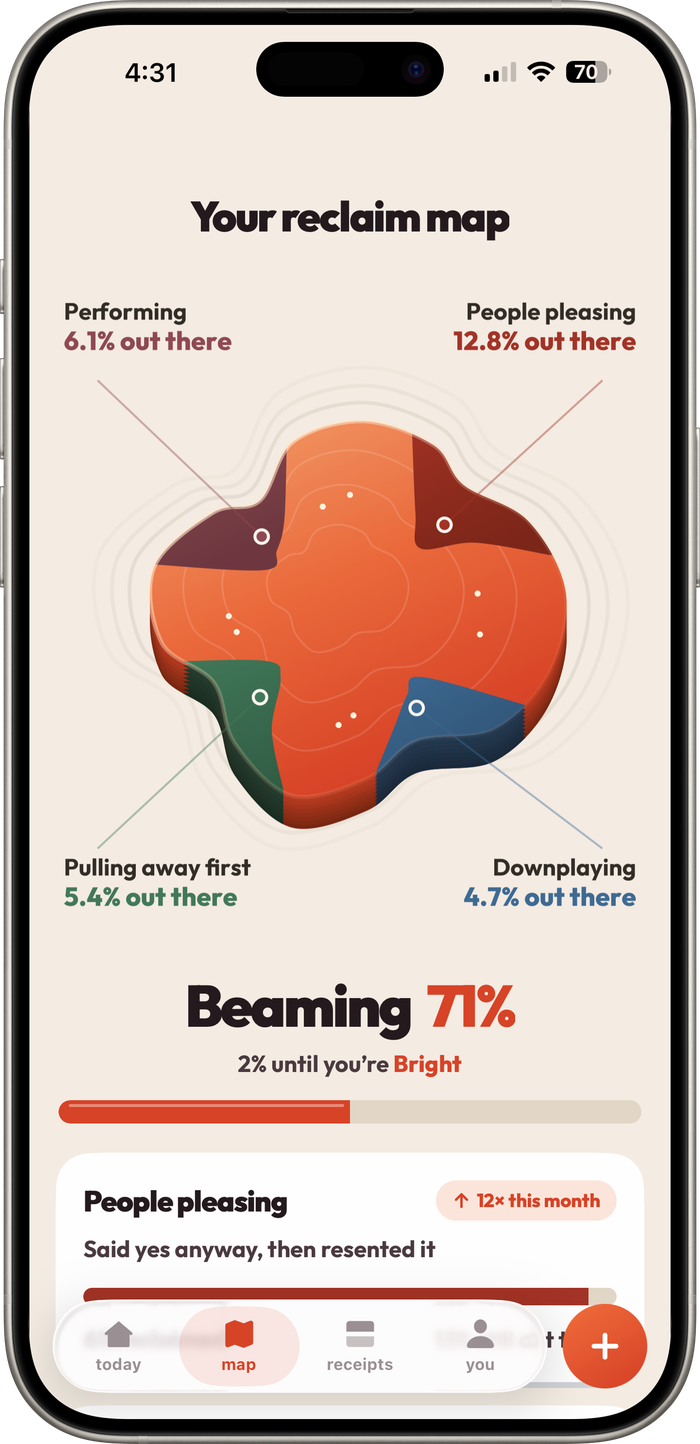
Your four patterns, each with a size that shrinks as you take yourself back. Proof, in one picture.
A blank page asks for effort and shows you nothing back.
Diary apps keep 6.1% of their users past day 30. In one study, people with a paper diary said they filled it in 90% of the time, and a sensor hidden in the cover said 11%.
Glissa asks for a tap instead of a page, keeps the score for you, and moves your number when you do.
Baumel and colleagues, JMIR, 2019 · Stone and colleagues, BMJ, 2002
People pleasing, anxious attachment, hyper-independence and eight more. The quiz finds your four, sizes them, and writes your first dare from the biggest.
People pleasing
Hyper-independence
Losing yourself
Anxious attachment
Pulling away first
Not saying what you think
Downplaying
Accepting breadcrumbs
Being everyone’s therapist
Peace feels boring
PerformingEvery step in the app rests on a published study. Every card here opens the paper it came from.
Noticing the habit, then doing something else in its place, is what carried the effect. That is the round and the dare.
Woods and Miltenberger, 1995 · J Behav Ther Exp Psychiatry
Writing down what you do shifts it the way you want, on its own. Unreliably, which is what the dare is for.
Korotitsch and Nelson-Gray, 1999 · Psychological Assessment
Across 94 studies and 8,461 people, deciding when and where you would do one thing had a medium-to-large effect on doing it.
Gollwitzer and Sheeran, 2006 · Adv Exp Soc Psych
Across 26 trials and 1,524 people, scheduling small rewarding actions beat doing nothing by a wide margin. Next to treatment the gap narrows.
Ekers and colleagues, 2014 · PLoS ONE
Across 16 trials and 2,407 people, a programme with points and visible progress beat the same programme without them.
Mazeas and colleagues, 2022 · J Medical Internet Research
In six weeks, the people who counted their blessings once a week got happier, and the group that did it three times a week did not move. That is why the dare is weekly.
Lyubomirsky, Sheldon and Schkade, 2005 · Review of General Psychology
No, and the app says so. Glissa is a daily practice, and if you are in a crisis it shows you who to call, and it means it.
You tap. The one place you can write is the vent, and only when you want to.
Glissa gives you a number that moves and a dare to move it, and it shows you the answers the number came from.
Free to download. The plan is $7.99 a week or $59.99 a year, with everything behind it, and you cancel any time in your App Store settings.
Your taps stay on your phone. What you type in the vent is read by the model only after you say yes, and it is never used to train anything. There is no account, so nothing is tied to your name.
No. A bad week cannot touch it, and it moves when you take something back.